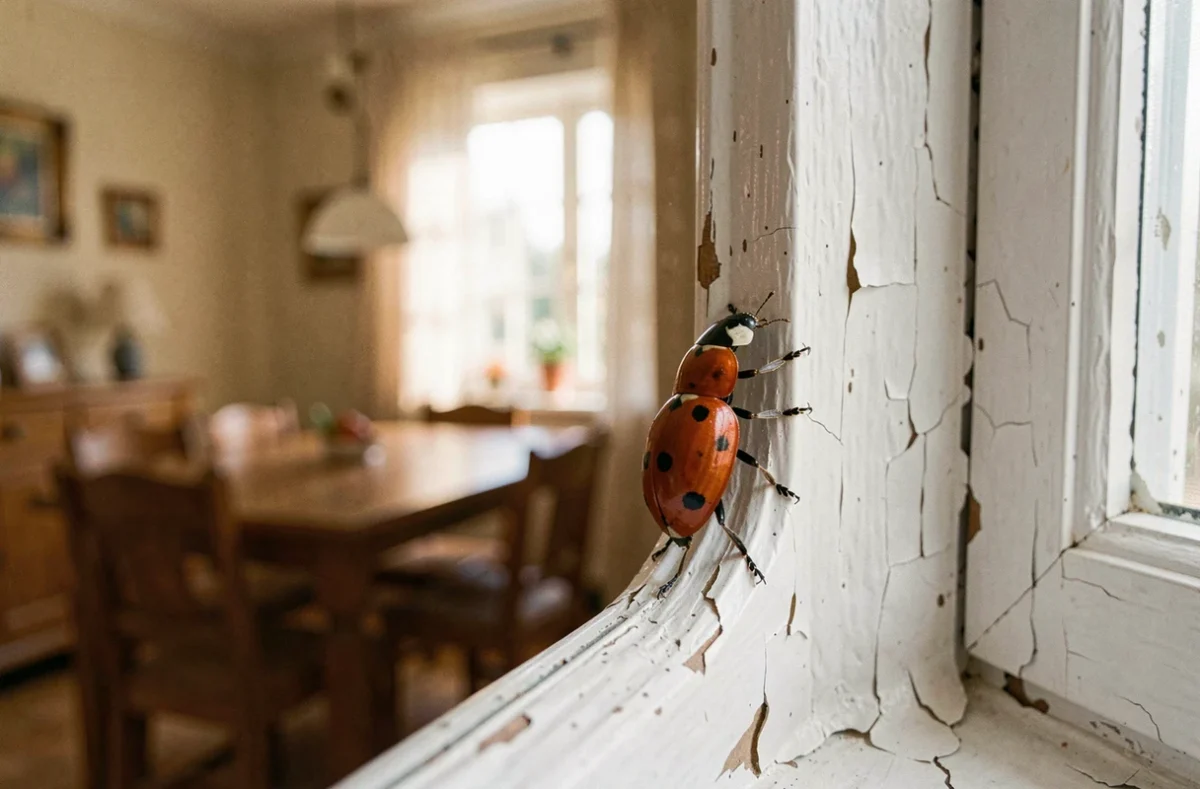
Several dozen ladybugs clustered on a window frame, a south-facing wall, or a Velux ledge: this phenomenon surprises every autumn. Before seeking a remedy, it is essential to understand what we are really observing, as the species involved, the timing of their appearance, and the insect’s behavior determine the appropriate response.
Native ladybug or Asian ladybug: identification chart
The majority of mass gatherings inside homes are not caused by the classic European seven-spotted ladybugs. The species involved is almost always the multicolored Asian ladybug (Harmonia axyridis), introduced for biological control against aphids and has become invasive.
A visual criterion allows for a quick distinction: the Asian ladybug has a white marking in the shape of a M or W behind its head, on the pronotum. Native species do not have this mark.
| Criterion | Seven-spotted ladybug (native) | Asian ladybug (Harmonia axyridis) |
|---|---|---|
| Size | Smaller | Larger and more robust |
| Mark on the pronotum | Absent | White M or W pattern |
| Autumn behavior | Overwinters outdoors, under bark | Clusters on sunny facades then enters walls and attics |
| Defensive secretion | Low | Yellow-orange liquid, unpleasant odor, stains surfaces |
| Health risk | None | Possible irritation of sinuses, skin, or respiratory symptoms in sensitive individuals |
Identifying the species is not just an entomological exercise: the response to be given varies entirely depending on whether one is facing a few stray ladybugs or a massive gathering of Asians. You will find information on the presence of ladybugs on Robion that details this distinction and its practical implications.

Defensive secretion and stains: the real domestic problem
The Asian ladybug does not attack wood or stored food. It does not bite in the strict sense, although it can pinch the skin slightly. The main inconvenience comes from its defensive reaction.
When it feels threatened or is crushed reflexively, it releases a yellow-orange liquid. This fluid stains painted walls, fabrics, carpets, and emits a persistent odor. Crushing is the worst possible reaction to this insect.
In some individuals, the secretions can also trigger irritation of the respiratory tract or skin. This risk remains limited to sensitive profiles (allergic, asthmatic), but it explains why a gathering of several hundred individuals in a closed space warrants intervention.
Removing ladybugs without damage
The cleanest method is to gently vacuum them with a vacuum cleaner set to low power. Two precautions must be observed:
- Empty the bag or container immediately outside, far from the facade, to prevent the insects from finding their way back into the house
- Do not use insecticide indoors once the ladybugs are settled in the walls, as inaccessible corpses may attract other pests (dermestids, carpet beetles)
- Place a piece of fine fabric between the tube and the hose to capture live insects if you wish to release them in the garden
Windows, cracks, and screens: act before the autumn gathering
The timing of the intervention matters more than the product used. Asian ladybugs identify hibernation sites as early as late summer. They head towards the warmest facades, then infiltrate through the smallest crevices: worn window seals, cracks in frames, unprotected vents, poorly sealed attics.
Any preventive action should therefore be carried out before this gathering, ideally at the end of spring or during the summer. Waiting until October to seal up means trapping the insects already present in the walls.
Priority entry points to check
- Window and door seals: check for airtightness and replace split or detached seals
- Screens: ensure they cover all openings, including transoms and ventilation grilles
- Cracks in frames and exterior cladding: seal with appropriate caulk
- Attics and under-roof spaces: install fine mesh on ventilation openings while maintaining airflow
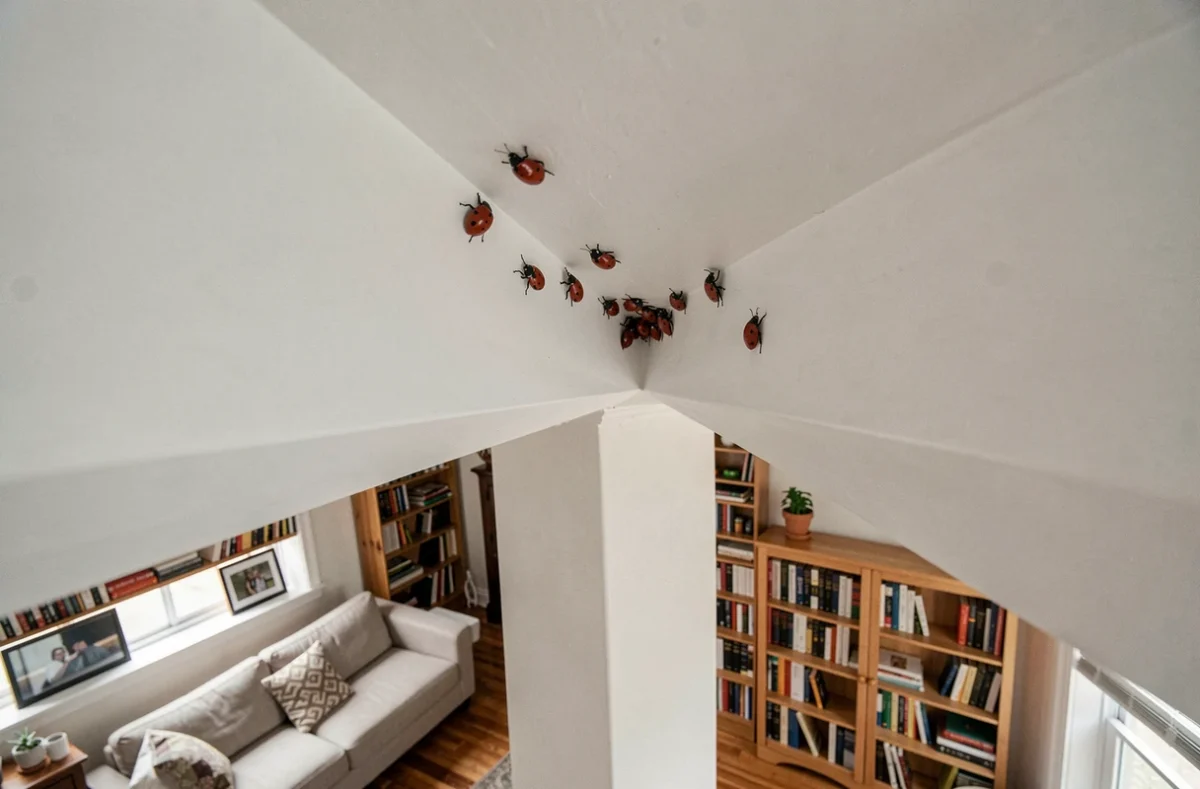
However, chemical treatments applied to facades before the season remain a debated topic. Their effectiveness depends on the surface to be covered and the persistence of the product, and they raise questions about the impact on pollinators and native species.
Ladybugs in the garden: a helper not to be confused with a pest
All ladybugs, including the Asian one, are voracious predators of aphids. Their presence in a garden or on a balcony indicates an active ecosystem. Systematically destroying individuals observed outside would deprive plants of a natural ally against pests.
The distinction to be made is spatial: outside, the ladybug fulfills its role as a helper. Inside, in large numbers, it becomes a nuisance that must be managed without brutality.
An isolated ladybug resting on a curtain in the middle of winter does not warrant any intervention. It will leave on its own when the warm days return. Only massive gatherings in walls or attics call for action, and this action remains mechanical (vacuuming, sealing) rather than chemical.
The most useful reflex when facing ladybugs in the house is not to look for an insecticide, but to identify where they are entering. A poorly sealed window frame or a vent grille without a filter is enough to explain the presence of hundreds of individuals every autumn. Fixing the entry point just once resolves the problem for the following seasons.