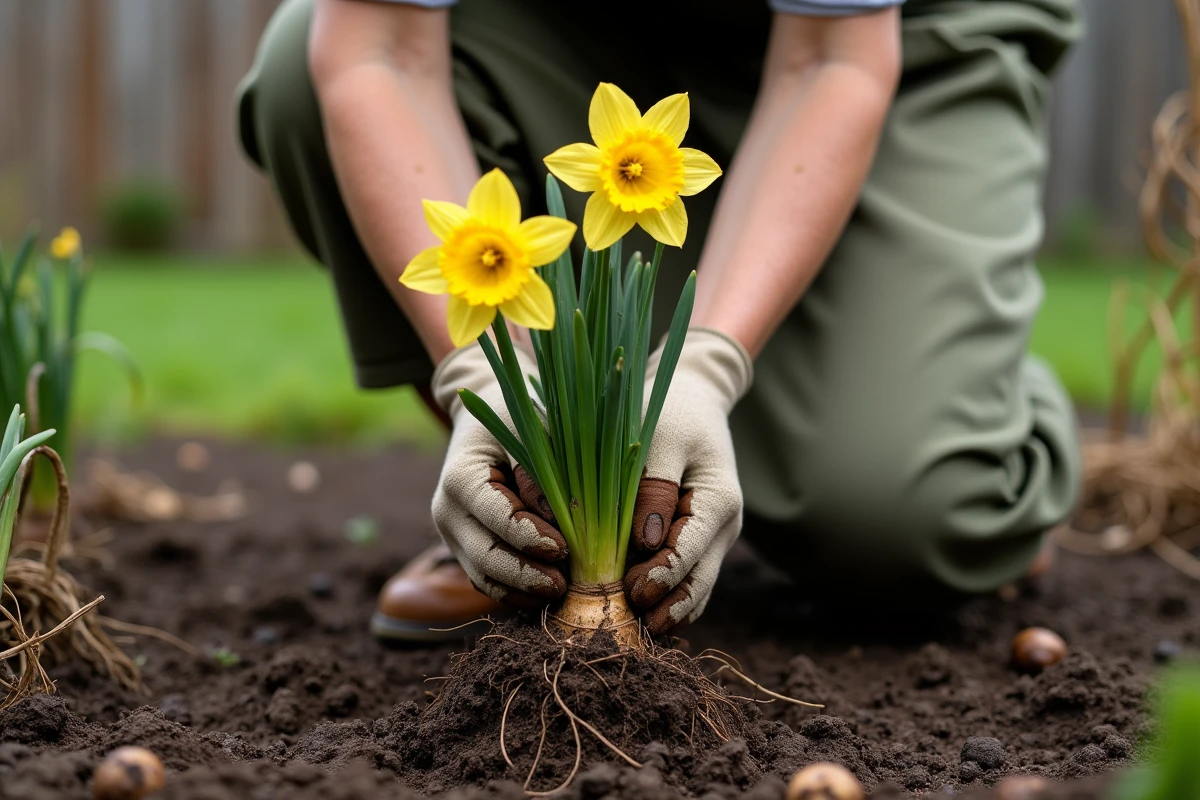
Daffodils (Narcissus) are among the most self-sufficient bulbs in the garden. Their systematic removal after flowering is a reflex inherited from the management of summer bulbs, not a physiological necessity. We recommend assessing on a case-by-case basis, depending on the density of the clumps and the vigor of flowering observed from year to year.
Daffodil bulb recharge phase: the mechanism to respect
Flowering depletes the starch reserves of the bulb. What follows, the recharge phase, directly conditions the quality of the next flowering. The foliage remains the only photosynthetic organ capable of replenishing these reserves.
The foliage must remain in place until it is completely yellowed. Cutting, braiding, or tying the still-green leaves reduces the assimilation surface and compromises the storage. For naturalized daffodils in lawns, this means delaying the first mowing in the planted areas.
Withered flower stems, on the other hand, should be cut as soon as flowering is over. Allowing them to go to seed diverts some energy towards fruiting, to the detriment of the bulb. A clean pair of pruning shears and a cut at the base of the stem: this is the only useful action at this stage. To delve deeper into this often misunderstood issue, you can discover Envies de Jardin which details the complete sequence between flowering and storage.
Daffodils in the ground or removal: concrete decision criteria
The majority of daffodils can remain in place for several years without intervention. We observe productive clumps in areas that have not been disturbed for over a decade, provided the soil is well-drained and the density does not become excessive.
Removal is only justified in specific situations:
- Flowering decreases significantly from year to year, indicating that the bulbils are competing for water and nutrients. Dividing and replanting with proper spacing restarts the cycle.
- The soil retains too much water in summer (compact clay soil, poorly drained bed base). Bulbs left in place risk rot during summer dormancy.
- A redesign of the bed requires moving the bulbs. This is an opportunity to sort, separate sizes, and only replant healthy bulbs.
Outside of these cases, leaving daffodils in the ground remains the most effective strategy. Naturalization in meadows or under trees is based on this principle: plant and let it be.
Removal and off-ground storage of daffodil bulbs
When removal is necessary, the timing and method are as important as the decision itself.
When to remove daffodil bulbs
Not before the foliage has completely yellowed. This is the signal that the recharge is complete and the bulb is entering dormancy. Forcing removal while the foliage is still green is like harvesting an unripe fruit.
We use a fork rather than a flat spade to limit damage to the bulbs. A nicked bulb is an entry point for fungi (Fusarium, Botrytis).
Preparation before storage
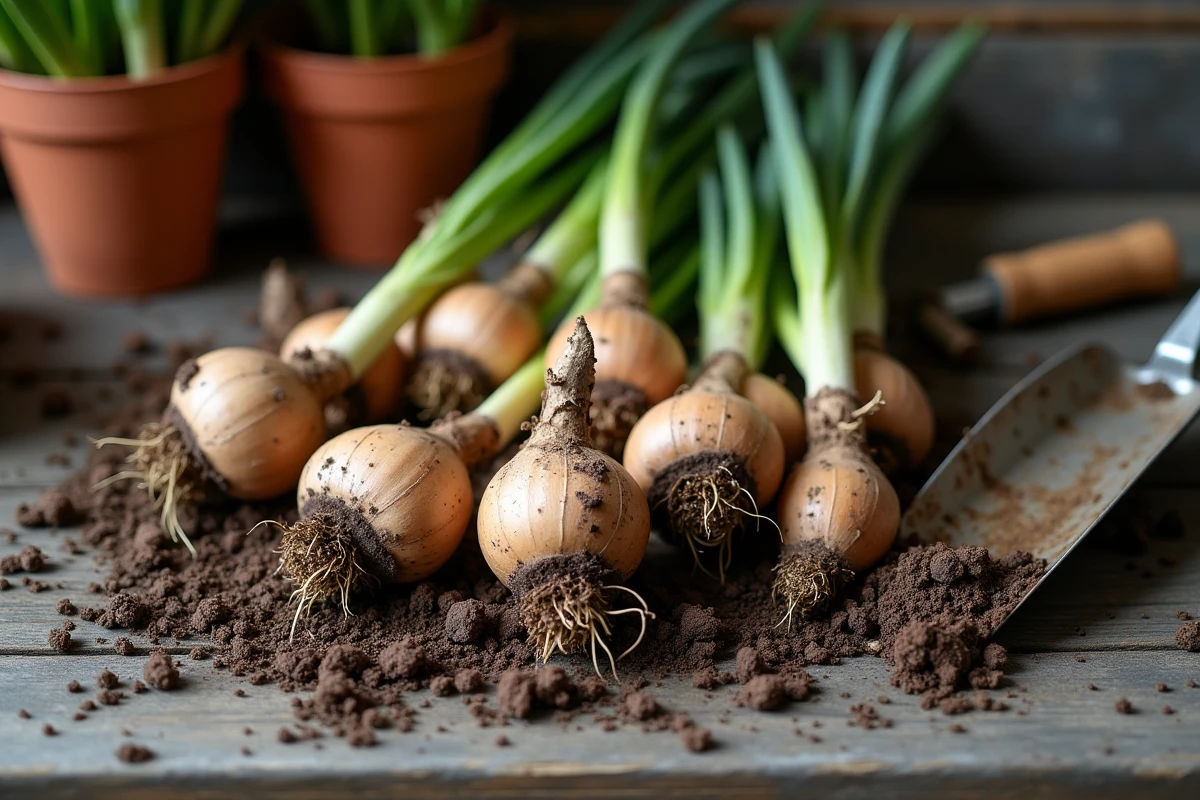
After extraction, the bulbs undergo a brief cleaning (removal of soil, without washing with water) followed by drying in the shade for a few days. The goal is to harden the outer tunics, which form a natural barrier against dehydration and pathogens.
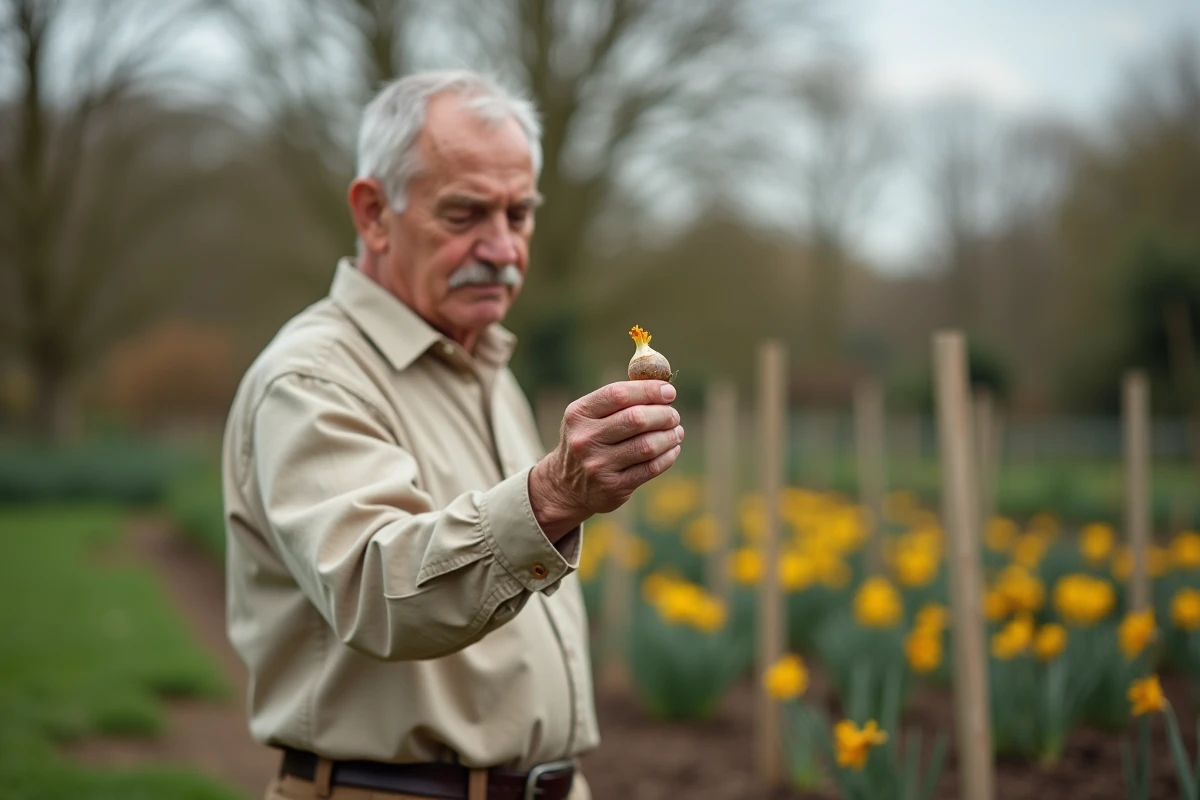
A sorting is necessary at this stage. Soft, stained, or abnormally light bulbs are discarded. Small-caliber bulbils can be replanted in a nursery to grow larger, but they will not flower for one to two years.
Storage conditions for bulbs
A dry, ventilated room with a stable temperature is suitable for summer storage. Nets, crates, or paper bags allow for sufficient air circulation. Closed plastic bags are to be avoided: they trap moisture and promote mold.
The ideal is a cool place, sheltered from direct light. We check the stored bulbs every few weeks to spot and remove those showing signs of rot.
Replanting daffodil bulbs in autumn
Bulbs stored off the ground are replanted in autumn, before the first frosts. The planting depth follows the classic rule: two to three times the height of the bulb. For a standard daffodil bulb, this represents about ten centimeters below the surface.
The soil must be loosened and well-draining. In heavy soil, adding coarse sand or gravel at the bottom of the planting hole limits the risk of stagnation. We avoid fresh manure in direct contact with the bulb, which promotes rot.
The spacing between bulbs determines the longevity of the bed. If too close, they quickly compete with each other, and flowering declines in a few seasons. A spacing of two to three bulb diameters between each bulb allows room for the bulbils that will naturally form.
Maintenance of daffodils left in the ground
For bulbs that remain in place, maintenance is limited to a few actions. Adding potassium fertilizer after flowering, when the foliage is still green, supports the replenishment of reserves. Excess nitrogen promotes foliage at the expense of the next flowering.
Very dense clumps should ideally be divided every three to five years, at the end of dormancy. The entire clump is unearthed, the bulbs and bulbils are separated, and replanted immediately or after a short drying period.
Naturalized daffodils in lawns require one concession: do not mow the planted area until the foliage has yellowed. A few weeks of patience in spring is enough to ensure regular flowering year after year, without ever touching a single bulb.